
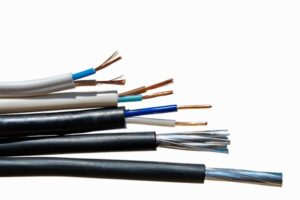
 Wire conductors are made from different materials, each with advantages that make it the best choice for specific applications. The wire and cable industry uses various metal conductors, but copper and aluminum are the two that stand out the most. Both these metals are ideal carriers of electric current, preferred for their efficiency, ease of use, and affordability.
Many favor copper for its superior conductivity. It is also strong, durable, corrosion-resistant, and less prone to expanding and contracting over time. Its high ampacity protects it from overheating. However, copper wires cost more than aluminum ones, and their weight requires more support over long distances.
Aluminum, on the other hand, is a popular choice for large-scale projects, as it is cheaper and lighter, making for faster installation. Aluminum wires are safe to use as long as they are installed correctly.
Variations of Copper and Aluminum Conductors
Copper and aluminum conductors come in various types that differ in composition and application. Below are some of the common variations of both copper and aluminum conductors.
Copper
- Bare Copper Wire: Readily available and cost-effective, bare copper wire is best suited for dry indoor applications where corrosion is not a concern. It also comes in different types, and is often either soft-drawn or hard-drawn.
- Soft-drawn: Solid, flexible, and versatile, this type is easy to work with and form into place. Soft-drawn copper wire is often used for overhead drive transmissions, as well as for circuit grounding, bonding, and equipment.
- Hard-drawn: Stiffer than soft-drawn wire, hard-drawn copper wire is best for applications that do not require bending around corners. Its higher tensile strength makes it a great overhead wire, and it is also popular in railroad, industrial, and outdoor applications.
- Tinned Copper Wire: Uninsulated and instead coated with tin, tinned copper wire is known for its corrosion resistance, making it ideal for high-humidity, marine, industrial, and other similarly harsh environments.
- Oxygen-free Highly Conductive (OFHC) Copper Wire: This high-purity copper wire is typically used for power superconductors, cryogenics, power distribution, and telecommunications.
- Tinsel Wire: Commonly found in our everyday portable devices, like our mobile phones and headphones, tinsel wire is composed of thin copper wire strands wrapped in polyester film, providing flexibility and durability suitable for frequent bending.
Other forms of copper wire include alloys and other clad or coated variations, such as copper nickel and nickel-plated copper wire, titanium-clad copper wire, and silver-coated copper wire.
Aluminum
- AA-1350 Series Aluminum Alloy: Made of at least 99.5% aluminum, this low-cost, highly conductive alloy used to be widely popular in residential wiring systems.
- AA-8000 Series Aluminum Alloy: Safer and more similar to copper, this alloy is preferred by most modern builders and manufacturers, and exhibits better creep resistance and elongation.
Overhead transmission cables are largely made of aluminum, as it is lighter and more affordable than copper. Aluminum wire types used in power lines include AAC (all-aluminum conductor), AAAC (all-aluminum alloy conductor), ACSR (aluminum conductor steel-reinforced), and ACAR (aluminum conductor alloy-reinforced).
Conclusion
Copper and aluminum are the widely known and preferred wire conductor materials, and for good reason — on top of being excellent conductors, they’re also ductile and corrosion-resistant. But in the vast world of wires and cables, you’ll find that many different materials are used as conductors, and each one brings its own unique characteristics.
For high-quality wire and cable solutions made only with the best materials, such as virgin copper, browse our official website or send us an inquiry. Level up your wiring today!